
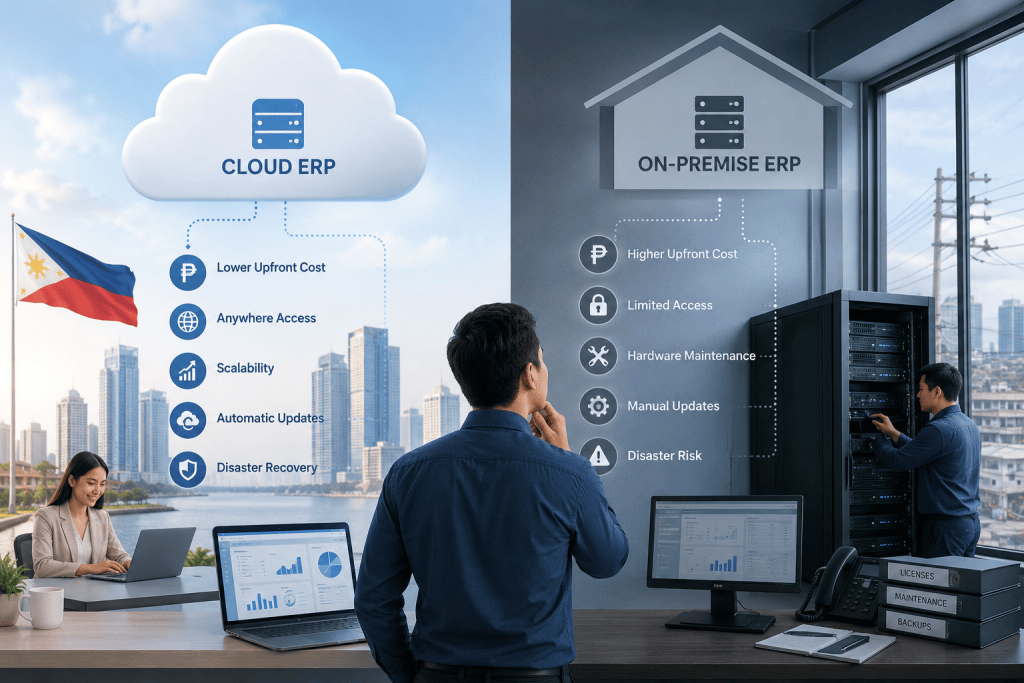
This decision used to come down mostly to budget and IT preference. It doesn’t anymore. The Philippines’ new e-invoicing mandate has quietly changed the calculus for a lot of businesses, and if you’re weighing cloud against on-premise ERP right now, understanding that regulatory piece matters as much as the usual cost and control tradeoffs.
Cloud and on-premise ERP each solve real problems well, and neither is a universally correct choice. The right answer depends on your specific compliance obligations, your IT capacity, your growth trajectory, and honestly, how much you want to be the one managing servers versus paying someone else to worry about that. Here’s what actually matters for a Philippine business making this call right now.
The Regulatory Piece That Changes Everything
The Bureau of Internal Revenue’s Electronic Invoicing System, or EIS, is reshaping this decision in a way that didn’t exist even a couple of years ago. Under Revenue Regulations No. 11-2025, covered taxpayers must issue structured electronic invoices in JSON format and transmit them to the BIR within three calendar days of the transaction, with the first major compliance deadline set for December 31, 2026. This covers large taxpayers, e-commerce businesses, exporters, and any business using a Computerized Accounting System or Computerized Books of Accounts with electronic invoicing.
Your ERP or accounting system needs to be able to generate that structured JSON data, apply a digital signature, and transmit it to the BIR’s EIS platform via API. Having existing CAS accreditation doesn’t automatically mean EIS compliance either — they’re separate systems, and confirming with your current or prospective ERP provider whether their platform can actually produce EIS-compliant output is now a genuinely necessary question rather than a nice-to-have.
“We’re getting a lot more calls lately from businesses specifically asking whether their system can handle EIS transmission, and it’s usually the first real question now, ahead of the classic cloud-versus-on-premise cost conversation. The compliance deadline forces the timeline in a way that budget alone never did.”
Why This Tends to Favor Cloud ERP, But Not Automatically
Cloud ERP providers generally handle regulatory updates, including EIS integration, as part of their ongoing service, pushing updates to all customers on a shared platform rather than requiring each business to manage its own compliance patch individually. This is a genuine, practical advantage when a regulatory deadline is looming, since it shifts the burden of keeping pace with BIR requirements onto the vendor rather than your own IT team.
That said, on-premise systems aren’t automatically disqualified from EIS compliance — a properly maintained on-premise system with a knowledgeable IT team and a responsive vendor can absolutely achieve compliance too. The real question is whether your specific vendor relationship and internal IT capacity can keep pace with a mandate that’s still evolving, not whether cloud is inherently the only compliant option.
Comparing the Real Tradeoffs
| Factor | Cloud ERP | On-Premise ERP |
|---|---|---|
| Upfront cost | Lower — subscription-based, minimal hardware investment | Higher — hardware, licensing, and implementation costs upfront |
| Regulatory updates | Handled by vendor across the platform | Requires internal IT or vendor support to implement individually |
| Data control | Data hosted by the provider, governed by your service agreement | Data stored on your own infrastructure, under your direct control |
| Internet dependency | Requires reliable connectivity to access the system | Functions independently of internet connectivity |
| Scalability | Generally easier to scale users/modules as the business grows | Scaling often requires additional hardware and licensing investment |
| IT staffing needs | Lower — vendor manages infrastructure and maintenance | Higher — requires dedicated IT resources for maintenance and updates |
Data Privacy: A Real Consideration Either Way
Regardless of which deployment model you choose, compliance with the Philippines’ Data Privacy Act of 2012, enforced by the National Privacy Commission, applies to how your ERP system handles personal data, whether that data lives on a cloud provider’s servers or your own on-premises infrastructure. Cloud providers serving the Philippine market should be able to speak specifically to how their data handling practices align with these requirements, and this is a fair, reasonable question to ask directly during vendor evaluation rather than assuming compliance by default.
Internet Reliability: A Genuinely Practical Philippine-Specific Factor
Cloud ERP’s dependence on stable internet connectivity is a more meaningful consideration in the Philippines than it might be in markets with more uniformly reliable infrastructure, particularly for businesses operating outside Metro Manila or in areas where connectivity can be less consistent. This isn’t a reason to automatically rule out cloud ERP, but it is a genuine, practical factor worth weighing honestly against your specific location and connectivity reality, rather than assuming a cloud system will behave identically everywhere in the country.
Cost Considerations Beyond the Sticker Price
On-premise ERP typically involves a larger upfront investment in hardware, licensing, and implementation, but potentially lower ongoing costs once that initial investment is absorbed. Cloud ERP spreads costs into predictable subscription payments with lower upfront investment, but ongoing subscription costs accumulate over time and should be compared against the on-premise total cost of ownership over a comparable multi-year period, not just against the smaller monthly payment in isolation.
Factoring In the Cost of Compliance Itself
Given the EIS mandate, factoring in the cost of achieving and maintaining e-invoicing compliance, whichever deployment model you choose, is now a genuine and necessary part of the total cost comparison. A cheaper system that can’t achieve EIS compliance without significant additional investment isn’t actually the lower-cost option once that compliance cost is included in the picture.
Making the Decision for Your Specific Business
For a fuller side-by-side breakdown of these factors specific to the Philippine market, the cloud vs. on-premise ERP comparison for the Philippines covers this decision in more depth, walking through the specific tradeoffs relevant to local businesses navigating both the cost question and the current regulatory environment.
For businesses earlier in the process, still evaluating what an ERP system actually needs to do for their specific operations before even reaching the cloud-versus-on-premise question, the ERP system guide for Philippine businesses covers the foundational considerations worth working through first.
Cloud vs. on-premise ERP for Philippine businesses — quick reference: The regulatory driver: BIR’s EIS mandate (RR No. 11-2025) requires structured JSON e-invoices transmitted within 3 days for covered taxpayers, with a December 31, 2026 first compliance deadline. Why this often favors cloud: vendors typically handle regulatory updates across the platform rather than requiring individual on-premises patches. On-premise can still comply: it requires strong IT capacity and a responsive vendor relationship — not automatically disqualified. Data privacy: Data Privacy Act compliance (National Privacy Commission) applies regardless of deployment model — ask vendors directly how they handle this. Internet reliability: a genuine Philippine-specific factor for cloud ERP, especially outside Metro Manila — weigh honestly against your actual connectivity. Cost comparison: compare total cost of ownership over several years, not just upfront price — and factor in the cost of achieving EIS compliance itself.
Frequently Asked Questions
Does the BIR’s e-invoicing mandate affect my choice between cloud and on-premise ERP?
Yes, meaningfully. Under Revenue Regulations No. 11-2025, covered taxpayers must generate structured JSON e-invoices and transmit them to the BIR’s Electronic Invoicing System within three calendar days, with a December 31, 2026 first compliance deadline. Cloud ERP providers typically handle these kinds of regulatory updates across their platform, while on-premise systems require your own IT team or vendor to implement compliance individually, making this a genuinely important factor in the decision beyond the traditional cost comparison.
Which businesses are required to comply with BIR e-invoicing by the 2026 deadline?
The first phase covers large taxpayers under the BIR’s Large Taxpayers Service, e-commerce and online businesses, exporters, and businesses using a Computerized Accounting System or Computerized Books of Accounts with electronic invoicing. Micro taxpayers are currently exempt from mandatory compliance but can voluntarily adopt e-invoicing. Confirming your specific taxpayer classification with the BIR or your accountant is the reliable way to know your actual compliance timeline.
Is on-premise ERP still a viable option given the new e-invoicing requirements?
Yes, on-premise ERP can still achieve EIS compliance, but it requires a knowledgeable internal IT team or a responsive vendor capable of implementing the necessary updates individually, rather than receiving them automatically as part of a shared cloud platform update. The real question is whether your specific IT capacity and vendor relationship can keep pace with a still-evolving regulatory requirement, not whether on-premises systems are inherently excluded from compliance.
Is cloud ERP more expensive than on-premise ERP over time?
This depends on the comparison timeframe. Cloud ERP typically has lower upfront costs but accumulates ongoing subscription payments over time, while on-premise ERP involves a larger upfront investment in hardware and licensing with potentially lower costs once that investment is absorbed. Comparing total cost of ownership over a multi-year period, rather than just the smaller monthly cloud payment in isolation, gives a more accurate financial picture for your specific situation.
How does internet reliability affect the cloud ERP decision in the Philippines?
Cloud ERP requires stable internet connectivity to function, which is a more meaningful practical consideration in areas of the Philippines with less consistent connectivity, particularly outside Metro Manila. This doesn’t automatically rule out cloud ERP, but it’s a genuine factor worth weighing honestly against your specific business location and connectivity reality before committing to a cloud-based system.
Does the Philippines’ Data Privacy Act apply differently to cloud versus on-premise ERP?
The Data Privacy Act of 2012, enforced by the National Privacy Commission, applies to how personal data is handled regardless of whether your ERP system is cloud-based or on-premise. Cloud providers serving Philippine businesses should be able to speak specifically to how their data handling practices align with these requirements, and asking this directly during vendor evaluation is a reasonable, important step regardless of which deployment model you’re considering.