
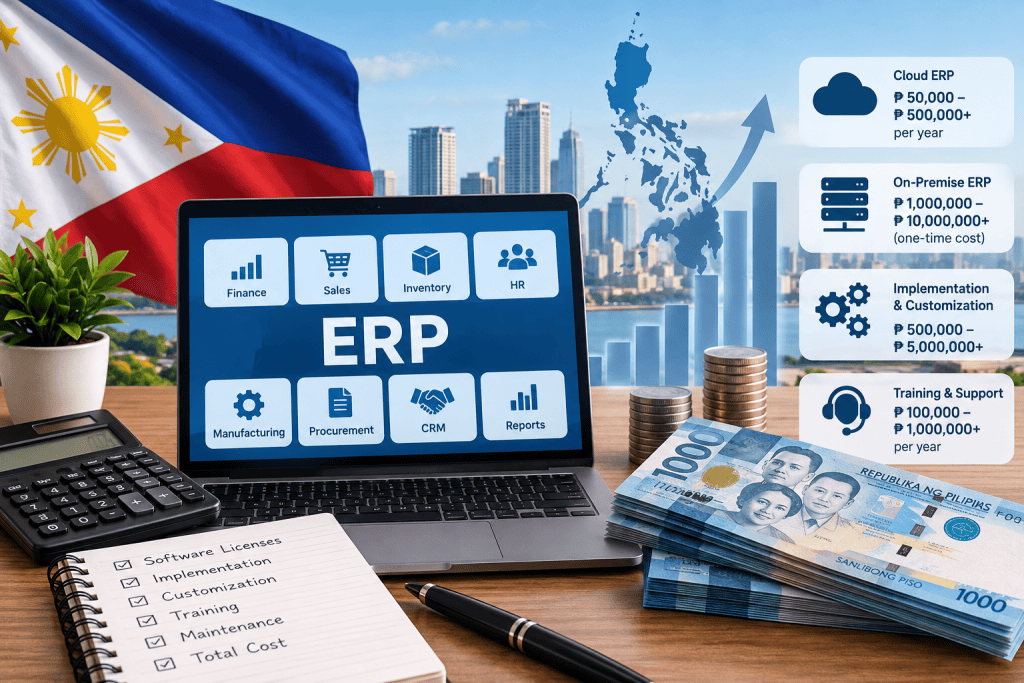
This is genuinely the first question every business asks, and it’s also the hardest one to answer honestly with a single number. Anyone who gives you a flat figure without knowing your user count, your modules, your data situation, and your deployment preference is guessing. Here’s what actually drives ERP cost, and how to get a number that’s real for your specific business rather than a generic industry average.
This post explains the real factors that drive ERP pricing and shares publicly available industry benchmark data for context. It isn’t a specific price quote — actual cost for your business depends on your particular requirements, and getting quotes directly from vendors is the only reliable way to know your real number.
ERP pricing varies so widely that industry benchmark figures, while genuinely useful for understanding cost drivers, can be misleading if applied directly to a smaller Philippine business without adjustment. Most published ERP cost research reflects a global mix of company sizes, including a lot of large, complex enterprise deployments, so understanding the actual variables behind the price is more useful than fixating on any single average number.
What the Broader Industry Data Actually Shows
According to Panorama Consulting Group’s 2026 ERP Report, average ERP implementation costs across their global benchmark sample run in the hundreds of thousands of dollars, with cost per user averaging in the thousands of dollars depending on complexity and customization level. That figure includes everything from small businesses to large multinational deployments, which is exactly why it’s not directly usable as “the” cost for a specific Philippine SME — it’s a blended average across a very wide range of company sizes and project complexity levels.
What’s more genuinely useful from that same research is the finding that more than a quarter of organizations exceed their original ERP project budgets, with the leading cause being additional technology needs discovered mid-project. That’s a genuinely important pattern regardless of your specific budget size: cost overruns tend to come from underestimated scope, not from the base software price itself.
“The number people fixate on going in is always the software license cost, and that’s honestly one of the more predictable line items. The costs that actually blow up a budget are almost always data migration, integration with existing systems, and customization that wasn’t scoped properly at the start. That’s true whether you’re a five-person shop or a five-hundred-person company.”
The Real Cost Drivers Behind Any ERP Project
Number of Users
Most ERP pricing, particularly for cloud systems, scales with the number of users who need system access, whether priced per seat monthly or as part of a broader licensing tier. A five-person finance team needs a fundamentally different license count than a fifty-person operation spanning finance, inventory, and sales.
Level of Customization
Standard configuration using a system’s built-in workflows costs considerably less than custom-built modules, bespoke reporting, or industry-specific logic layered on top of the base platform. Industry research consistently identifies heavy customization as one of the biggest single drivers of both cost and timeline overruns, since custom work requires far more development and testing time than configuring existing features.
Data Migration Complexity
Moving historical records from an old system into a new ERP is one of the most consistently underestimated cost components in any implementation. A business migrating a couple of years of relatively clean data faces a very different cost than one migrating a decade of records across multiple old, poorly maintained legacy systems.
System Integrations
Every connection your ERP needs to make to another system, whether that’s a POS platform, an e-commerce store, or a separate CRM, adds both cost and complexity. Businesses often discover additional integration needs partway through implementation that weren’t part of the original scope, which is a genuinely common source of budget overrun.
Cloud vs. On-Premise Deployment
Cloud ERP typically involves lower upfront costs spread into ongoing subscription payments, while on-premise systems require a larger upfront investment in hardware and licensing. Which model actually costs less for your business depends on your specific timeline and how you value predictable ongoing payments against a larger one-time investment.
Why a Philippine SME’s Actual Number Looks Different From Global Averages
Global ERP benchmark data skews toward larger organizations with more complex, multi-site, heavily customized deployments, which naturally pulls average figures upward. A small or mid-sized Philippine business implementing a more standard configuration, with a moderate user count and reasonable data migration scope, should expect a meaningfully different, more modest total cost than a headline global average would suggest. This is exactly why getting a specific quote based on your actual requirements matters more than anchoring to any published industry average.
Getting an Accurate Number for Your Specific Business
The only reliable way to know what an ERP system will actually cost for your business is to work through your specific requirements, including user count, needed modules, data migration scope, and any required integrations, with a vendor who can quote against your actual situation rather than a generic package. The ERP implementation guide for the Philippines covers what the actual implementation process involves in more detail, which is useful context for understanding where your specific budget will actually go once you move from evaluating cost to planning a real project.
Questions to Ask Before Getting a Quote
Before requesting quotes, having clarity on your actual user count, which specific business functions need to be covered (finance, inventory, HR, sales, or some combination), how much historical data needs to migrate, and what other systems the ERP needs to talk to gives vendors what they need to quote accurately, rather than giving you a rough, unreliable ballpark based on incomplete information.
ERP cost in the Philippines — quick reference: No single universal price: cost depends on user count, modules, customization, data migration, and integrations — not a fixed industry number. Global benchmark context: Panorama Consulting’s 2026 ERP Report shows global averages skew toward larger, more complex enterprise deployments — not representative of a typical Philippine SME project. Common budget overrun cause: more than a quarter of organizations exceed their original ERP budget, most often due to additional technology/integration needs discovered mid-project. Biggest cost drivers: user count, customization depth, data migration complexity, system integrations, cloud vs. on-premises deployment choice. Why SME costs differ from global averages: global data includes many large, complex deployments that pull the average upward — a standard SME implementation is typically far more modest. Best next step: get a specific quote based on your actual user count, modules, and data situation rather than anchoring to a published industry average.
Frequently Asked Questions
Is there a standard price for ERP systems in the Philippines?
No, there isn’t a single standard price, since ERP cost depends heavily on your specific user count, which modules you need, your data migration complexity, required integrations, and whether you choose cloud or on-premises deployment. Published industry benchmark figures are useful for understanding cost drivers but reflect a global mix of company sizes, including many large, complex deployments, so they shouldn’t be treated as a direct estimate for a typical Philippine SME project.
Why do ERP projects often go over budget?
According to Panorama Consulting Group’s research, more than a quarter of organizations exceed their original ERP project budgets, with additional technology needs discovered mid-project cited as the leading cause. This typically happens when integration requirements, customization needs, or data migration complexity weren’t fully scoped before the project began, rather than the base software license cost itself being the source of overruns.
What are the biggest factors that drive up ERP implementation cost?
The biggest cost drivers are typically the number of users needing system access, the level of customization beyond standard configuration, the complexity and volume of historical data being migrated, and the number of integrations needed with other systems like POS or CRM platforms. Heavy customization and underestimated data migration scope are particularly common sources of cost overruns across implementations of any size.
Is cloud ERP cheaper than on-premise ERP?
This depends on your specific timeline and how you weigh upfront investment against ongoing payments. Cloud ERP typically has lower upfront costs spread into predictable subscription payments over time, while on-premise ERP involves a larger initial investment in hardware and licensing. Comparing total cost over a multi-year period, rather than just the smaller monthly cloud payment, gives a more accurate picture of which option is actually less expensive for your specific situation.
What information do I need before getting an accurate ERP cost quote?
Having clarity on your actual user count, which specific business functions need coverage (such as finance, inventory, HR, or sales), how much historical data needs to migrate, and what other systems the ERP needs to integrate with gives a vendor what they need to provide an accurate quote. Without this information, any quote or estimate you receive is likely to be a rough, unreliable ballpark rather than a number you can actually budget around.
Why shouldn’t I use a global average ERP cost figure to budget for my Philippine business?
Global ERP benchmark data typically includes a wide range of company sizes, including many large, complex, heavily customized deployments that pull average cost figures upward significantly. A smaller or mid-sized Philippine business implementing a more standard configuration should expect a meaningfully different, generally more modest total cost than a global headline average would suggest, which is why a specific quote based on your actual requirements is far more useful than anchoring to a published industry average.