
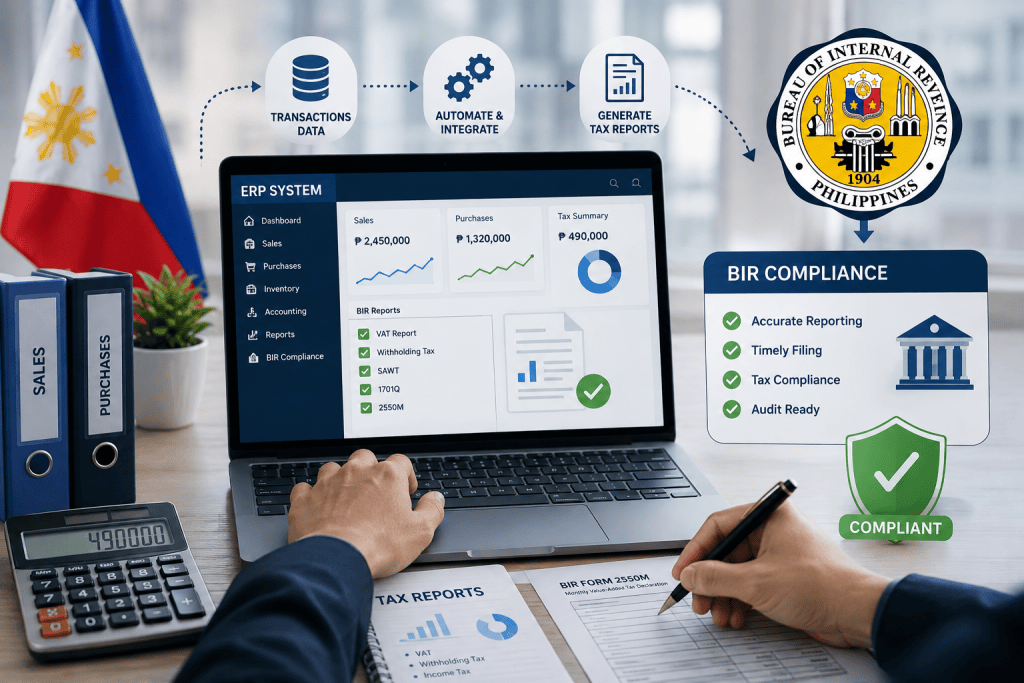
If your business falls under the BIR’s e-invoicing mandate, the calendar is the real issue right now. The deadline is December 31, 2026, which is roughly twelve weeks away, and the system work behind it takes longer than most people expect. Here’s what’s actually required, where an ERP genuinely helps, and where it doesn’t.
Scope note: This post is general information, not tax or legal advice. Whether and when the mandate applies to your business depends on your taxpayer category, so confirm your specific coverage with the BIR or a qualified tax professional.
Most BIR compliance trouble doesn’t come from people misunderstanding the law. It comes from data living in too many places. Sales sit in one system, invoices get generated in another, and the person preparing the filing is reconciling the two by hand at 11 p.m. on deadline day. An ERP won’t make your tax obligations simpler, but it can make the work of meeting them far less error-prone.
Where the E-Invoicing Mandate Actually Stands
The framework comes from Revenue Regulations No. 11-2025, which set up electronic invoicing and electronic sales reporting. The original compliance window was later extended by Revenue Regulations No. 26-2025. According to Aurea Da Law’s coverage of the mandate, covered taxpayers now have until December 31, 2026 to comply, and recent BIR guidance under RMC No. 98-2026 has moved the program closer to actual implementation.
That second part matters. Back when the extension was announced, it was easy to treat the deadline as someone else’s problem. It isn’t anymore. As BusinessMirror reported on September 29, the BIR is now moving ahead with mandatory implementation for covered taxpayers by year-end, even as many businesses are still asking for more time because of cost and difficulty.
Who Is Covered
The first group includes taxpayers under the Large Taxpayers Service, e-commerce businesses, exporters, and taxpayers using computerized accounting systems or computerized books of accounts, among others. The rules may also reach additional categories as the BIR builds out its electronic sales reporting infrastructure. If you’re unsure which bucket you’re in, that’s the first question to settle, before any software conversation.
What “Compliant” Actually Means
Covered taxpayers must issue structured electronic invoices in the BIR’s prescribed format, which is JSON, and transmit the sales data to the BIR’s Electronic Invoicing System within a few days of each transaction. A PDF emailed to a customer doesn’t count. The invoice has to be machine-readable data that validates against the BIR’s schema.
“The most common misunderstanding we hear is ‘we already have BIR-accredited accounting software, so we’re covered.’ Those are two different things. Accreditation for a computerized accounting system and readiness to transmit to the e-invoicing system are separate, and a lot of businesses find that out late.”
The Part Most People Miss: Scope and Penalties
One detail worth knowing: according to the BusinessMirror piece, the requirement due on December 31, 2026 is limited to electronic invoicing. The electronic sales reporting side of the framework follows separately. That narrows the immediate target, which is helpful, but it doesn’t make the invoicing piece small.
Non-compliance carries penalties. Under RR 11-2025, violations of the e-invoicing requirements fall under Sections 264 and 264-A of the Tax Code. The regulation also gives the Commissioner authority to extend the compliance period further if necessary, which is the sort of thing people latch onto as a reason to wait. Treating it that way is a gamble. Businesses that were counting on the March 2026 date being the final word have already seen how fast timelines shift, in both directions.
Why Spreadsheets and Patchwork Systems Struggle Here
E-invoicing is unforgiving about data quality. A structured invoice needs consistent customer details, correct tax codes, valid item data, and a clean link between the invoice and the underlying sale. If those fields live in different files maintained by different people, errors don’t surface until something fails validation, which is a bad time to discover them.
There’s also the audit trail. When a number on a filing gets questioned, you need to trace it back to the transaction, who recorded it, and when. Spreadsheets generally can’t tell you that. A system built around a single set of records can.
What an ERP Actually Does for Tax Compliance
An ERP system keeps sales, inventory, receivables, and accounting on one set of records, so an invoice is generated from the same data that feeds your books. That removes the re-keying step where most reporting errors creep in. The ERP System Philippines overview covers how this connected approach works for local businesses, including regulatory requirements specific to this market.
Fewer Manual Handoffs
When an invoice is created at the point of sale and flows automatically into receivables and the general ledger, nobody has to copy numbers between files at month-end. That alone eliminates a surprising share of reconciliation problems.
One Source for Tax Figures
Recurring filings like VAT and withholding taxes pull from the same transactions, so the figures on a return match the figures in your books by construction rather than by someone’s careful checking. The Financial Management page covers the accounting side of this in more detail.
Traceability When Questions Come Up
A system with change history and access controls can show who touched a record and when. If the BIR or an auditor asks about a specific transaction, you’re pulling a record, not reconstructing a story.
Where an ERP Doesn’t Solve the Problem
An ERP is not automatic compliance. Three things still need your attention. First, the system has to actually support EIS requirements: the structured invoice format, transmission to the BIR, and the related permits and certification steps. Don’t assume that because a vendor says “BIR-compliant,” it covers e-invoicing. Ask directly. Second, your own master data needs to be clean before it goes in, since a new system with messy customer and item records just produces messy invoices faster. Third, the Data Privacy Act of 2012 still applies to the customer information you hold, whichever system stores it.
A Realistic Timeline From Here
With about twelve weeks left, a full ERP implementation is a stretch for a business starting from zero. Typical projects run well past that, and data migration is where timelines most often slip. That doesn’t mean you’re out of options. It means being honest about sequencing: confirm whether you’re covered, find out whether your current setup can reach EIS readiness on its own, and only then decide whether this is a replace-the-system moment or a targeted-fix moment. For businesses already planning an ERP, the e-invoicing requirement is a good reason to ask about it in the first vendor call rather than the last.
Questions Worth Asking Any Vendor
Is the system EIS-ready, or on a documented path to it, and what’s the evidence? Who handles the permit and certification steps? What happens to invoices if transmission to the BIR fails? How are tax code updates delivered when regulations change? A vendor who answers these specifically is worth more than one who answers them confidently.
A Practical First Two Weeks
If you’re starting now, a sensible opening sequence looks like this. Week one: confirm your coverage, list every system that touches an invoice (point of sale, billing, accounting, any marketplace integrations), and name one person who owns the project. Week two: ask your current software provider for a written statement of EIS readiness and the steps remaining, and start cleaning customer and item records regardless of what you decide next. That cleanup is never wasted. It shortens any later migration, and it’s the cheapest risk reduction available while you’re still deciding.
| Item | Current Status |
|---|---|
| Governing regulation | RR No. 11-2025, as amended by RR No. 26-2025 |
| Compliance deadline (covered taxpayers) | December 31, 2026 |
| What’s due by that date | Electronic invoicing (sales reporting follows separately) |
| Recent guidance | RMC No. 98-2026 (e-invoicing policies and guidelines) |
| Penalties | Sections 264 and 264-A of the Tax Code |
| Further extension | Possible at the Commissioner’s discretion, not guaranteed |
BIR compliance and ERP — quick reference: Deadline: December 31, 2026 for covered taxpayers (RR 11-2025 as amended by RR 26-2025); roughly twelve weeks from now. Latest development: RMC 98-2026 has moved e-invoicing closer to implementation; the BIR is pressing ahead for year-end. Scope: the year-end requirement is limited to electronic invoicing; sales reporting follows separately. Common trap: accredited accounting software is not the same as EIS readiness — they’re separate. What an ERP helps with: fewer manual handoffs, one source for tax figures, and a traceable audit trail. What it doesn’t do: it isn’t automatic compliance — confirm EIS support, clean your master data first, and mind the Data Privacy Act. Don’t bank on another extension: the Commissioner can extend, but nothing guarantees it.
Frequently Asked Questions
What is the BIR e-invoicing deadline?
Covered taxpayers have until December 31, 2026 to comply with the electronic invoicing requirements under RR No. 11-2025, as extended by RR No. 26-2025. The Commissioner of Internal Revenue has authority to extend the period further, but there’s no guarantee that will happen, and recent BIR guidance suggests the agency is moving ahead with year-end implementation.
Does my business have to comply?
It depends on your taxpayer category. The first group includes Large Taxpayers Service taxpayers, e-commerce businesses, exporters, and taxpayers using computerized accounting systems or computerized books of accounts, among others, and coverage may expand. Confirm your specific status with the BIR or a qualified tax professional rather than assuming.
I already use BIR-accredited accounting software. Am I covered?
Not automatically. Accreditation for a computerized accounting system and readiness to issue structured e-invoices and transmit them to the BIR’s Electronic Invoicing System are separate things. Ask your software provider specifically about EIS readiness, including the format, transmission, and certification steps.
What happens if I miss the deadline?
Under RR 11-2025, violations of the electronic invoicing requirements are subject to the penalties in Sections 264 and 264-A of the Tax Code. The practical risk of missing the date is significant enough that treating December 31 as a backstop, rather than a target, is the safer approach.
Can an ERP be implemented before December 31?
Possibly, but it depends on your starting point. ERP projects commonly run longer than a few months, and data migration often causes delays, so a business starting from scratch has little margin. A more useful first step is confirming whether your current setup can reach EIS readiness, then deciding whether a full replacement or a targeted fix makes sense.
Is the December 2026 requirement only about invoices?
According to current reporting, the mandatory requirement by December 31, 2026 is limited to electronic invoicing. The electronic sales reporting portion of the framework follows separately, so the immediate target is narrower than the full regime, though still substantial.